Teaching Identity Updated Blog Post
- Joy Mistovich
- May 5, 2024
- 12 min read

Updated: May 26, 2024
Section 1: Teaching Identity
Over the past two years during my Art Education/Museum Education Master’s program at The Ohio State University, I have come to embrace, comprehend, and implement a unique teaching philosophy that combines connecting the disability and non-disability communities simultaneously and also my unique positionality. During my early semesters of the program, I adopted the ideology of qualitative research using the constructivist paradigm, which incorporates my passion for assistive technology, Disability Studies, and academic research. The greatest aspirations I have been able to achieve are due to combining all of my skills into one career path at The Butler Institute of American Art. It's hard to believe that nearly two and a half years have passed and how everything has come full circle. My ideology of providing hope, courage, tenacity, and comprehending the value of a positive philosophy of blindness has enhanced museum experiences for museum staff, docents, and visitors. For instance, reflecting back on the past several weeks is extraordinary, and my lived experiences as a blind person as well as my yearning to provide a springboard for change has allowed me the ability to create a unique platform. My actions, words, and projects within the Butler community and beyond have impacted countless lives, and as I have previously stated, I consider my blindness as a gift, rather than an obstacle. I possess the capacity to inspire and influence the outside world: not only the Youngstown community at large, but also, the state and nation. I was deeply humbled and privileged when I received the Ohio Museums Association Emerging Museum Professional of the Year Award in mid-April. I was both in awe and overcome with emotion that fellow museum professionals statewide had decided to select me for this prestigious honor even though I have only been a member of the museum field for a brief time. Earlier this year, I also received the opportunity to participate in the angular Emerging Museum Voices Fellowship Program through the Ohio Museums Association. This year long program enables me to connect and collaborate with museum staff statewide, representing minority communities and also fostering friendships with museum colleagues as well as the Executive Director of the Ohio museums association. With this opportunity, I have been able to combine my knowledge I've received from Ohio State to bridge the gap between diversity, equity, accessibility, and inclusion for everyone.
An unforgettable moment that sparked my foray into the visual arts and later becoming a Museum Educator transpired in 2017. That year was definitely a turning point for me within my life, since I came to realize that combining the power of Assistive Technology, an interest in the museum field, and truly feeling that I belonged in an incredibly visual world was home for me. At that time, I became an Aira Explorer (Aira User). Aira Users are referred to as explorers, since we can achieve almost any task imaginable with confidence, independence, and efficiency through combining unique skillsets and talents in an interdependent community. Aira (Access to Information Remote Assistance) connects blind and low vision individuals as well as other disabled and non-disabled persons to highly trained, professional and remotely located visual interpreters. Aira's service is activated through a smart phone or computer and provides instant access to visual information anytime and anywhere. Soon after my early adoption of Aira, I decided to go to the Butler and walk through the Museum independently for the first time. I was extremely uncertain at first of how this experience would transpire, but I was definitely excited as well. When I called in and was connected with a visual interpreter, she happened to be a visual artist herself. I explained to her what my end goal was and that I wanted to receive as much detail as possible in regard to some of the works at the Butler. She immediately began describing each work as I passed and also assisted me with navigating through the galleries. As we went from painting to painting, my heart beat more quickly, and I continued acquiring some basic knowledge regarding the complexities of artistic expression and engagement. I learned about shape, line, color, form, and also the positioning of objects within the work itself. At the conclusion of the tour, I was speechless and overcome with emotion. Up to that time, I had always enjoyed venturing into art museums and other cultural institutions, since both of my parents were former art educators and artists themselves — my dad passed away in 2019. However, this experience was different. For the first time ever, I could connect with someone who could truly explain an artwork to me, and I could stay at one specific piece for as long as I wished. I could easily navigate from one gallery to the next without fear or uncertainty of what was to come. From that moment on, it was my quest to discover my calling and passion in life.
Fast forward to seven years later where I have received the capacity to incorporate my teaching philosophy and epistemology, pedagogy, and research into my career and everyday life. I believe it is necessary to teach others within the museum field and elsewhere that in order to eliminate stereotypes, we must learn the significant challenges that ostracize minority communities. We must embrace and connect with like-minded and dissimilar human beings who share and diversify our skillsets and knowledge. The museum field, as well as the field of academic research, writing, and teaching in general is best approached by learning from others as we commence and explore our own paths and life journeys. There is always the great divide that separates the challenges and uncertainties from the incredible rewards concerning our role within the human race and community. Reflecting back on my role at the Butler as a museum educator and teacher, I can attest to the encouragement, empathy, and understanding that I have experienced from Museum staff, docents, visitors, Ohio State professors, as well as my fellow cohort. As I embraced the use of technology through Aira's service in experiencing museums as both a visitor and employee and also a blind researcher and visual artist, my teaching philosophy has soared. In 2017, through using Aira, I received my second set of wings to attain my most challenging and rigorous goals and aspirations independently, efficiently, and on my own terms. My ideology as a museum educator has been encapsulated by my continued push to assist all minority groups, regardless of ability or disability into the museum field. Too often, as a dominate western white society, we believe that there is only one specific philosophy, and if a minority group decides to implement an alternative philosophy, the latter group does not receive the ability to incorporate the alternative philosophy. Through research and incorporating the social model of Disability Studies and Disability Justice, I strive to shine a light on the meaning of ableism and challenging the status quo. Ableism isn't solely a phenomenon that transpires within the disability community itself, it also affects all minority groups as a whole since there is a great deal of work that must be achieved. For instance, the ideology behind Disability Justice is also referred to as rewriting the challenges and oppressive nature that have negatively impacted our work within the Disability Rights Movement.
Two major influential theorists who have inspired and challenged my work include Viktor Lowenfeld and Mia Mingus, since both of their perspectives provide a positive focus on art education and Disability Studies. Lowenfeld states:
It is difficult to conceive that during an era in which art education - especially in the elementary classroom - is considered an integral part of the total curriculum, most of the schools for the blind still think of art as a preparatory stage for professional art training and therefore out of the question for the schools for the blind. (qtd. in Reidmiller, 2003, p. 19)
Even though Lowenfeld's teaching within the art education field was during the mid-twentieth century, he was ahead of his time for perceiving the value of art education for blind and low-vision students. He believed that schools for the blind didn't consider art education as a necessary or a specific discipline to include within the holistic pedagogical approach for all students. Not until recently, art curriculums at schools for the blind are an integral part of the student experience, and when it comes to mainstream education, challenges still exist. Through my role at the Butler, I've received my passions for academic research, learning, engagement, and providing an inclusive/equitable experience for everyone. Each day, I strive to integrate my knowledge and skillset into my career to enhance the lived experiences of museum visitors from distinct economic backgrounds and minorities. One such implementation of my teaching identity can be traced to include research regarding museum trends, accessibility and assistive technology trends, and providing an opportunity for the disability and non-disability communities to experience the visual arts using the same playing field. Upon my hire at the Butler, one of the first projects I worked on was incorporating Aira access into the museum experience for not only myself, but also for museum docents and visitors. This project soon evolved into others including creating Braille and large-print brochures of new exhibitions, providing accessibility testing and feedback for the new Butler website, and also creating a sensory Sunday program for the neurodiverse community. This isn't the entirety of all of the projects I've undertaken in the past two and a half years, but this list provides a sampling of my integration of the visual arts for all communities.
Most significantly, Mia Mingus, one of the key Disability Justice advocates has profoundly influenced my Ohio State research and museum work. The significance of Disability Justice aligns with the American Alliance of Museum's philosophy that stresses diversity, equity, accessibility, and inclusion and each day brings new challenges and rewards as I continue eliminating visible and invisible barriers that stand in my way. This perspective isn't solely for myself, it involves enriching the lives of all individuals I meet along my life journey. Mingus (2011) writes in her blog post Changing the Framework: Disability Justice, How our Communities can Move Beyond Access to Wholeness,
Disability is framed as lacking, sad and undesirable: a shortcoming at best, a tragedy at worst. Disabled people are used as the poster children of environmental injustice or the argument for abortion rights. For many people, even just the idea that we can understand disability as “not wrong” is a huge shift in thinking. (para. 2)
Mingus (2011) continues to advocate for interdependence stating,
With disability justice, we want to move away from the “myth of independence,” that everyone can and should be able to do everything on their own. I am not fighting for independence, as much of the disability rights movement rallies behind. I am fighting for an interdependence that embraces need and tells the truth: no one does it on their own and the myth of independence is just that, a myth. (para. 8)
The second quote regarding independence and interdependence is significant. I whole-heartedly believe that the disability community can live independent and productive lives with the most appropriate tools and personal connections which fit their needs. However, there is also the realization of interdependence concerning the Ohio State community, the Butler community, as well as the Aira community. Through the lens of interdependence, I've discovered that connecting with like-minded individuals who believe in the positive, social model of disability studies, along with similar passions and fields of interest creates a bridge to connecting minority communities from different backgrounds, ethnicities, religions, genders, and more. Accomplishing an extremely complex task or aspiration using my knowledge from research, visual arts appreciation, and Aira's assistive technology service is one key example along with the Ohio State community, which connects my teacher identity to my path as a museum professional. In other words, each one of us possess specific intersectionalities that profoundly impact and enhance our life experiences and how we interact with the world around us.
Aira's service not only combines the power of technology, it encapsulates the philosophy of humanity into the equation who possess empathy, a positive understanding of blindness and disability, and also the reality that anything is possible through the power of combining similar and distinct skill sets simultaneously.
The Ohio State community also paves a way for interdependence concerning continued research, academic rigor, and learning. Through my museum career and participating in this master's program with a full-time position, I have come to value and embrace the power of countless perspectives and frameworks from my fellow cohort and professors. I have enhanced my knowledge and writing as I combine my positionality and academic research into each new project I pursue. Eliminating the negative perception of understanding other ethnic and racial groups has allowed me to explore the connections we all share as a community and a society. The binary between whiteness and non-whiteness can be shattered, and we can create a new perspective that focuses on all types of DEAI perspectives. With my teaching philosophy, I have constructed a perspective that involves listening, observing, writing, speaking, research, and also enhancing my foray and passion as a blind, emerging visual artist.
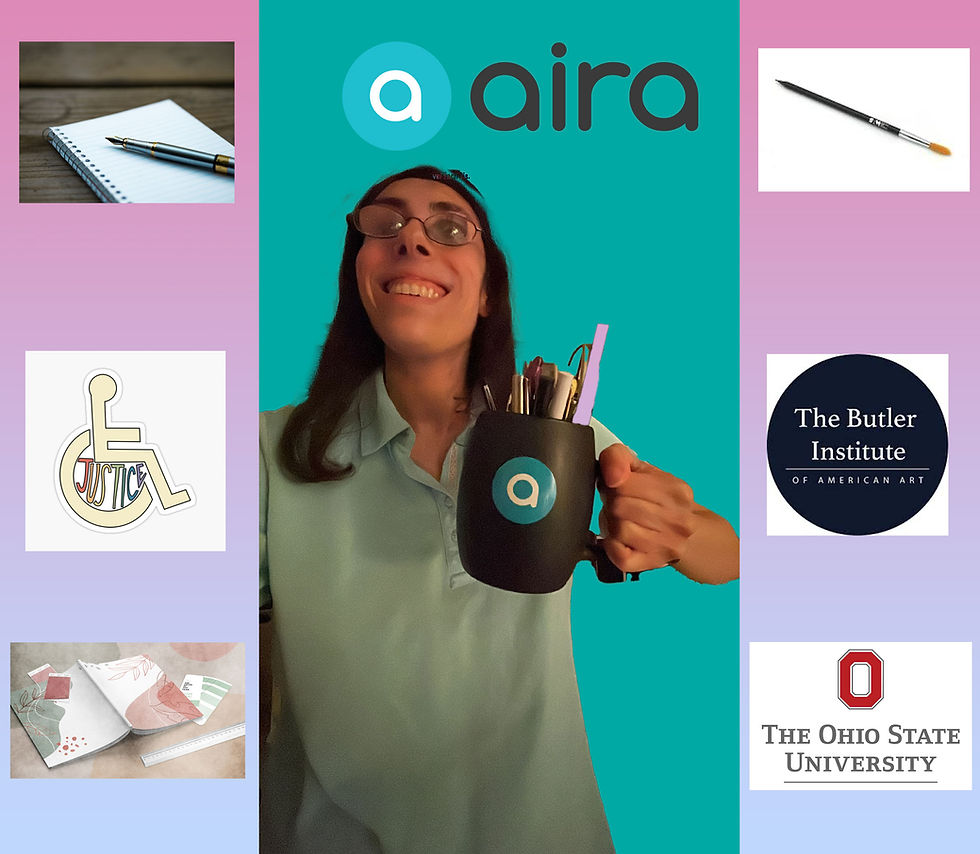
To culminate the understanding of my teaching identity and philosophy, I decided to incorporate one of my Ohio State art works and update the project. The work I found that most distinctly aligns with my philosophy is a photo of me holding an Aira coffee mug with the Aira background colors and the logo in the upper portion. To enhance this project, I placed the Butler logo, the Ohio State logo, an artistic textbook, a paper and pencil image, and also the Disability Justice symbol. All of these images and logos align with my passion as a blind visual artist, academic researcher, Aira explorer, Ohio State Buckeye, writer, and disability justice/accessibility pioneer. I decided to create the effect of having each image float in space with the central focal point including me as I'm surrounded with the Aira logo and the Aira blue background.
Section 2: Reflection
As I began the process of rewriting and editing my work, I first began by reading all of my previous assignments cited in the assignment instructions. Rather than copying and pasting work that I had written previously, I decided to take an entirely new approach but still keep some of the key teaching elements that I had included previously. Similar elements include: my research interests, my positionality, as well as impacting the disability community and beyond. However, there were several key differences that I also discussed. In my original first semester blog post regarding identity, I described several experiences that related to my previous academic work from former professors that had enhanced my research interests.
This time, I decided to further integrate my passion for assistive technology and the visual arts by discussing my Aira story from 2017. The reason behind this change is to describe in greater detail the power of combining assistive technology, humanity, and the realization of the social model of disability studies. This experience as a whole led me on a path of discovery, knowledge-seeking, and discovering my mission in life. This also allowed me to enhance my lived experiences as well as the challenges and stereotypes that exist regarding individuals who truly don't understand the positive philosophy of disability. It took many years of research, trial and error, and receiving the positive conviction that I could truly become a successful museum educator, technologist, blind visual artist, and academic researcher.
The most challenging phenomenon for me was applying to various positions that I thought would work well for me, but after countless opportunities of being denied these positions, I decided it was time for a different approach. The realization arose that in order to be a successful blind museum educator, I had to network and find professional, supportive friends and colleagues who would give me the opportunity to succeed. This reality, in turn, led me to receiving my previous job at Aira in 2019, and I was still deeply fascinated with the visual arts, technology, and the museum experience. When the pandemic occurred and my position was eliminated, I was disappointed, but I was determined to find my path once again. I again worked to update my resume and submit numerous other job applications without success. Towards the end of 2021, I decided it was time for me to think creatively and initiate my own career. I took the power that I had received through assistive technology tools, my skillset, and passions and researched/created my own job proposal with the assistance of Aira's technology service. I in turn shared my proposal and resume with the Butler's museum director, who was extremely impressed with my credentials. The only challenge was my foray into an art museum, and I had very little familiarity with specific aspects regarding the visual arts.
I was ecstatic when I received my full-time position at the Butler in November of 2021, but I still needed to receive an understanding of academic research and artistic engagement in order to become as successful as possible. Thus, it was time again to take all of the skills and knowledge I'd received and place them into searching for the art education/museum education program that was best for me. When I read about Ohio State's online program, as well as the faculty, and diversity of research interests, I decided to apply. I was deeply impressed with the program, and what made this experience even more unique was that the university as a whole is an Aira Access location, both online and in person, for everyone who could benefit from the service. Most significantly, this is the first time I had achieved such a lofty goal without the assistance of family. I used Aira to edit and proofread my application and other materials and then sent it off electronically. I was deeply uncertain of the outcome and wasn't sure if I would actually be selected, since it is an incredibly selective program. I couldn't believe when I received the email welcoming me to Ohio State, and at that moment, my life changed once again forever. I knew then that I could become a successful museum educator who possessed the knowledge and capacity to give back to the minority community through the visual arts. This was definitely a powerful realization, and as I have embraced each new challenge and experience, my teaching identity has allowed me to reach my full potential.
Most significantly, I have comprehended that there are countless mechanisms that create barriers for all members of minority communities, whether it is through race, gender identity, religion, disability, ethnic diversity, and more. However, the visual arts provide a safe space for everyone - regardless of ability or disability - to express themselves and intertwine their distinct similarities and differences within all corners of the world. There is so much more to the visual arts than just the visual aspect itself. Through my role at the Butler, I have embraced the visual experience, along with other multi-sensory experiences, to vastly improve each visitor's perspective of American art.
Works cited:
Reidmiller, L. (2003). Art for the Visually Impaired and Blind: A Case Study of One Artist’s Solution [Dissertation Art for the Visually Impaired and Blind: A Case Study of One Artist’s Solution]. https://etd.ohiolink.edu/acprod/odb_etd/ws/send_file/send? accession=osu1054144608&disposition=inline
Mingus, M. (2011, February 12). Changing the Framework: Disability Justice. Leaving Evidence. https://leavingevidence.wordpress.com/2011/02/12/changing-the- framework-disability-justice/

Comments