Program Reflections
- Joy Mistovich
- May 19, 2024
- 8 min read

Updated: May 26, 2024
Reflective Practice:
During my Ohio State program, I have learned about the significance of reflection, analysis, and implementation. Whether it was creating an artwork for my teaching studio activity class or writing a lesson plan, each course built upon the significance of acquiring new knowledge, challenging the status quo, and also expanding the current and future possibilities. Prior to enrolling, I wasn't familiar with specific aspects surrounding social justice. I knew very little about this topic, but I was extremely excited to delve in and begin my work as an academic researcher and museum educator. I was also unfamiliar with the basic and more complex framework of art education and museum education, since my career path was taking shape over time. I knew in order to become a successful and productive museum field professional, I had to build upon the specific skills given to enhance my knowledge further.
I began this program with awe, emotion, and wonder as I came to understand the oppressive nature of multiculturalism in art education with Dr. Richardson. Prior to this class and the program in general, I was unfamiliar with the aspects of critical race theory and abolitionist teaching, and I was determined to learn as much as I could about these new subjects. During this course, we were asked to reflect upon specific readings and connect, extend, and challenge our thinking. This ideology in itself was the basis that I implemented as I completed each new assignment, not only for my first course, but also for all of my other courses to come. I learned about the three-legged stool within the employment, education and housing sector, and how this oppressive stereotype impacts members of the minority community as a whole. In relation to this ideology arises the significance of abolitionist teaching. Abolitionist teaching demonstrates the three-legged stool approach concerning the difference between minority communities and our white dominated society.
Bettina Love's book (2019),"We Want To Do More Than Survive", discusses the components of abolitionist teaching, which include the following: "Abolitionist work and teaching is the practice of working in solidarity with communities of color while drawing on the imagination, creativity, refusal, (re)membering, visionary thinking, healing, rebellious spirit, boldness, determination, and subversiveness of abolitionists to eradicate injustice in and outside of schools" (Love,2019,P. 1). As I came to realize the significance of reflective practice, I continued to implement this philosophy into my museum work and also my Ohio State work. Another key aspect of the reflective practice concept focuses on implementing current practices that are used within the museum field or school setting and demonstrating how this can impact research, teaching, and art making.
One of the most memorable assignments that relate to the aspect of reflective practice as a whole was when we were asked to write about challenges and positive experiences that we currently faced last semester. I decided to focus on the implementation of a tactile George Washington exhibit, and my greatest challenge was to initially find members of the blind and low vision community who could tour The Butler between mid-February and early June. In this check in assignment, I also discussed how my uncertainty evolved in to hope as a friend, and I worked collaboratively to contact various blindness organizations. Since we completed this task, hundreds of people have toured the exhibit including blind and low vision visitors, as well as disabled and non-disabled visitors.
Transformative Courses:
One of the most influential classes throughout my Ohio State program was the Overview of Research for Arts Educators. This course provided the framework for learning about various types of research within the art education/museum education field and also provided the opportunity for me to expand my writing capability. We first began by reading about specific types of research, which included: qualitative and quantitative research methods and practices. To gain a greater understanding of research techniques, we spent time learning about a specific research area over several weeks. To further enhance our learning, approximately two or three students were broken into groups to complete a research-based assignment. Our group chose to focus on mixed methods and quasi-experimental research as we gathered materials to supplement these areas of study. We were asked to write a paper regarding a summary of the research methods and also the key takeaways of implementing this type of research. Later on in the course, we were asked to read various excerpts concerning the similarities and differences between writing in an academic style and also combining our lived experiences. This aspect of the course is what impacted me most, and I learned then that it was possible to enhance my writing by not only providing an academic perspective, but also, I could use my own voice.
In the excerpt Writing the New Ethnography chapter 4 by H. Lloyd Goodall (2000) he states the following:
Akin to the function of self-disclosure in friendships, authorial character is derived from how your persona narrates the story, treats people in it, reflects on experiences in the field, and explains things. Your persona also creates perceptions of the kind of person you are. Personal history passages, choices of theoretical framing and explanatory metaphors, displays of human vulnerability and emotions, the questions you ask, the way in which you arrive at answers-all of these narrative and rhetorical devices reveal your motives, goals, habits of mind, and behavior. (pp. 131-132)
This profound statement was the spark that ignited my identity as both a writer and academic researcher. Prior to this program, whenever I worked on academic writing, I always thought it had to be extremely straight to the point and without emotion or positionally, since I hadn't learned about these topics during my first Master’s program. After reading several key excerpts from other sources besides this previously stated quotation, I realized the possibility of exploring my own viewpoints, emotions, academic interests, and more. This is when my writing truly soared and became the gateway for expressing my academic interests, passion as a museum educator and blind researcher, and demonstrating to others the possibility surrounding combining academic writing and research.
One other extremely intensive research project we worked to complete was our mini research assignment where I posed questions surrounding the similarities and differences between blind and sighted children, students, and adults concerning the arts. My passion for artistic engagement and Disability Studies definitely continued to thrive after the conclusion of this course.
The other course that truly provided me the opportunity to express myself within the visual arts was Teaching Studio Activity. Within this course, we were asked to combine the elements of art making, play, and meaning making into our art assignments and also in the final research paper. Over the course of the semester, I completed a plethora of art projects using a combination of multi-sensory experiences to enhance both the blind and sighted community as a whole. I realized that I could become an effective and emerging blind visual artist by incorporating nonsense techniques and strategies that enhanced the visual world around me.
In Sydney Walker's book Art Making, Play, and Meaning Making (2021), she states the following:
Innovation, invention, and unconventional thinking readily associate them-selves with art learning and art making, but the reality is that art making in the classroom and the artist’s studio can fail to live up to these descriptors. As art educators, we desire to see students experiment and approach ideas from new perspectives, but we often struggle with how to achieve this state of affairs.
This excerpt aligns with the significance of being able to create a specific type of artwork using unique material and settings for the project. Each project I completed provided me the confidence and competence to express myself more thoroughly through artistic creation and describe how I had completed the specific project.
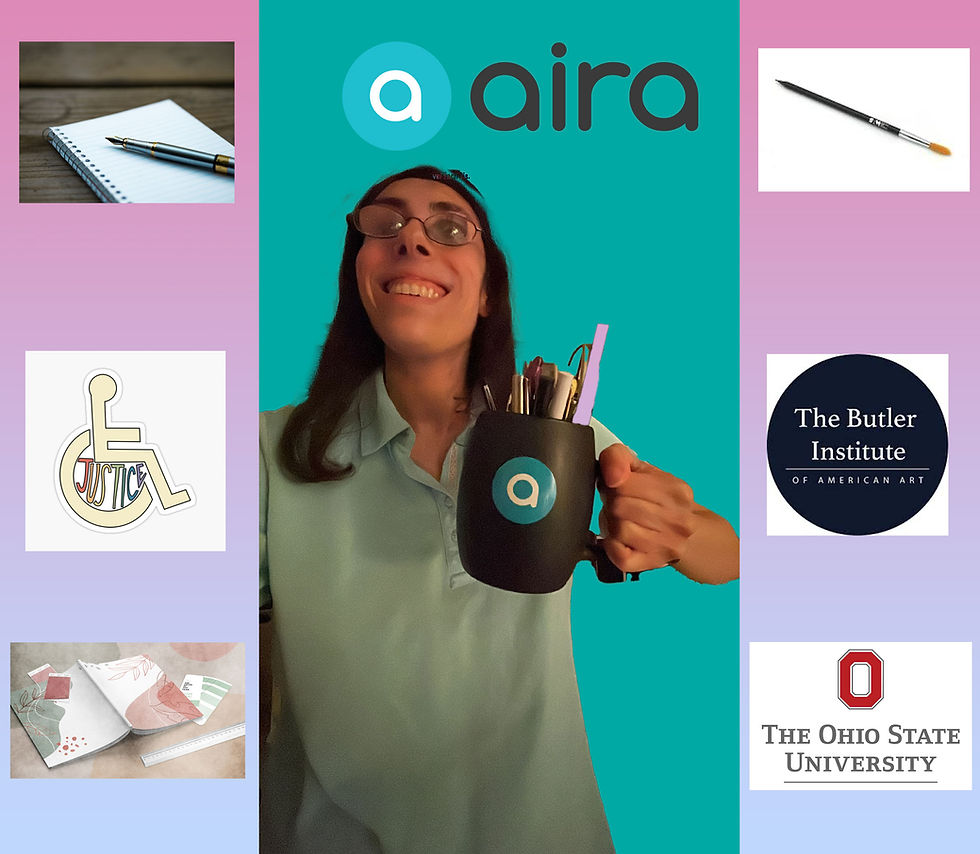
For example, in my first assignment, we were asked to create self-portraits using specific play strategies and nonsense techniques. I randomly chose the strategies of marginalization, inclusion, and relocation. Through these three techniques, I learned more about my artistic practice, my passion and implementation of artistic expression, and the reasoning behind creating the artwork. In my first two projects, I focused on including my self-portrait in my office at The Butler. However, instead of showing the plain white walls of my office, I changed the background in photoshop to create the effect of an art gallery. I used Aira to assist in the process as I went through various templets in photoshop. I also turned my white cane into a dragon staff. Visual Interpreters looked for an online image that we could place on top of my traditional white cane, and we ended up cropping the image to make it fit exactly with the dimensions of my work. Once I had completed this first artwork, I was extremely excited, and I gained a great deal of confidence from working on this project. I realized that as a blind academic researcher and museum educator, I could combine my positionally and life experiences into the artwork I created to make it appealing and unforgettable. Some artists only focus on creating the artwork itself, but in Dr. Richardson's class, we learned the significance of art making, play, and meaning making to provide a more robust interpretation of the vast ray of possibilities surrounding artistic creation.
Reflections:
Over the course of my Master’s program, I have learned to become a more effective teacher, academic researcher, museum educator, and blind visual artist. I have received the skills and knowledge to enhance visitor experiences for a wide array of communities through interaction, engagement, understanding, and listening. I have come to realize that the white dominated visual arts sector must change, and now, more than ever, western organizations and museums are pushing the boundaries between what is typically shown in a museum setting. Several decades ago, it was more common to see a vast array of European and other western cultures within the museum setting, but now, museums from across the country and worldwide are beginning to initiate key changes that encompass an array of minority groups. This is definitely a significant and profound step that will enhance DEAI principles and practices. I am deeply passionate about continuing my research in areas of interest within the areas of accessibility, Assistive Technology, museum education, and Disability Studies. My course work has provided a springboard of change to complete the transition of how art was previously portrayed in historical context to how it is currently viewed. I found the phenomenon most interesting within the multiculturalism and art education course. The fact that truly struck home for me is the lack of diversity and unique voices within the museum community and beyond. This will take time, but as the practice of diversifying collections of unique voices evolves, museums and other cultural institutions will need to remain at the forefront of sharing multiple artistic lenses and world views. Prior to this program, I was definitely uncertain of how a vast majority of community members were represented or more specifically, how they were previously represented. How can current and future museum trends continue to illuminate their stories and experiences? How is this practice similar to the exploration of the western artistic canon and how has it changed? Why is it necessary to include these groups of individuals, why do museums elicit these stereotypes of upper-class society and prestige with uninviting atmosphere. How has this philosophy changed over time? These questions are only a few that have come to mind as I continue to learn and grow in my knowledge seeking process, and the conclusion of the program, I am interested in continuing to research several of these topics as well as other disability related elements within the artistic community. I am extremely grateful and deeply passionate about providing the most accessible and inclusive art experience for visitors, docents and employees. My newest passion lays at the intersection of disability arts and providing the disability community the opportunity to express themselves through the arts as museums and galleries recognize their work as credible story tellers and creators. My future goal is to continue to push for the disability community to have a voice within the visual arts sector so that their work is just as significant as non-disabled artists. Moreover, when museums purchase works by disabled artists this creates the potential for a new wave of inclusion and intersectionality within the museum field and beyond.
References:
Love, B. (2019). We Want To Do More Than Survive: Abolitionist Teaching and the Pursuit of Educational Freedom. Beacon.
H Lloyd Goodall. (2000). Writing the new ethnography. Altamira Press.
Walker, S. (2021). Artmaking, Play, and Meaning Making. Davis Publications

Comments