Joy’s Hmm…Collection
- Joy Mistovich
- Feb 26, 2023
- 7 min read

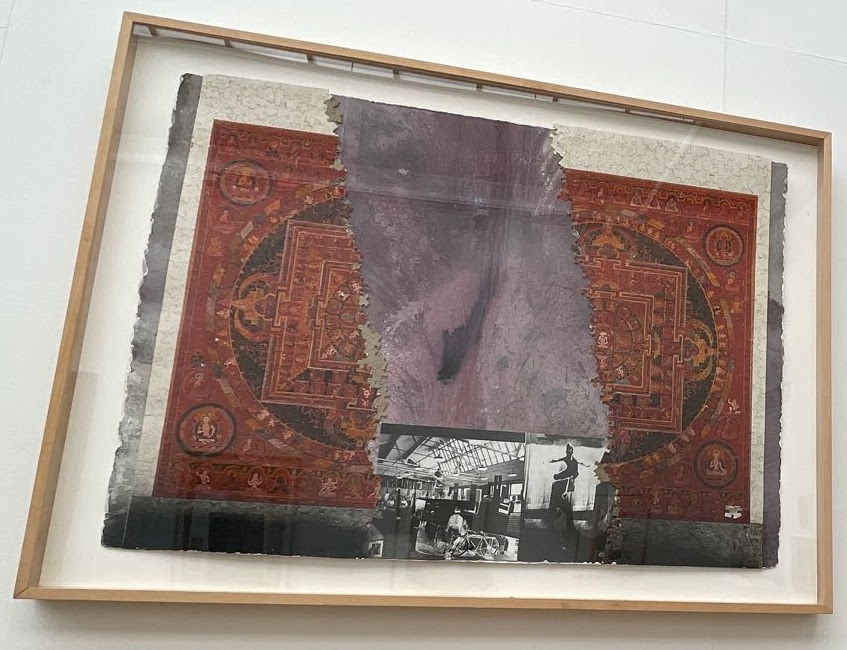
Titled: Anatomy of a Cloud: Break Labyrinth by Paul Jenkins. This looks like a red colored Indian tapestry torn in half and stitched back together with old black and white photographs

“Untitled” by Nicholas Krushenick This is an abstract pop art styled piece with blue background, white spikes on top of a yellow/red colored hill. Reminds me of Sonic the hedgehog rolling down a hill
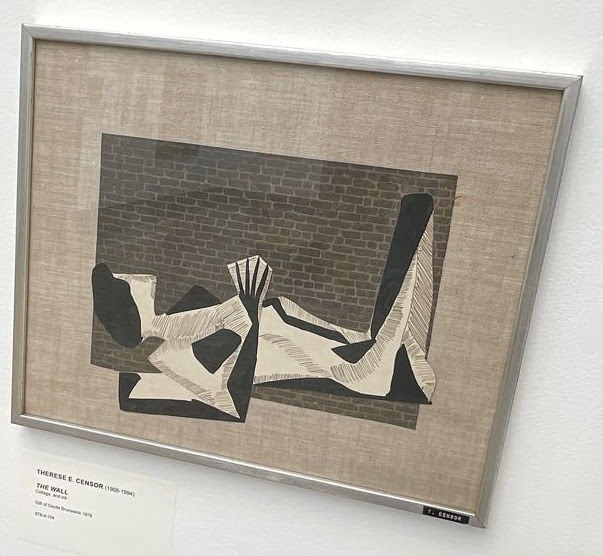
“The Wall” by Therese E Censor Looks like a woman getting therapy in front of a gray wall. Woman is lying down on her back, hands clasped and knees tucked in.

“Wind at My Door” by Dorothy Churchill-Johnson shows fall leaves on top of a rope/straw woven door mat. Wind blew them down to the mat.

“Still Life with Ferdinand” by Aaron Bohrod looks like a Toy Story scene. Things are coming to life after leaving the frame…what was once in a picture frame is now playing outside. Straw vaquero man and various objects on a table

3- Inch Brush by Ben Schonzeit (1981) It is a large version of a brush once used. Black ink still seen on the ends of the bristles.

“Last Light” by London Amara Sun about to fully set in an outdoor scene. Woodsy background with a river. Photographed in a very dark way.

“Two Ways” by Alberta Cifolleli This is a colorful pastel styled landscape piece depicting a skittle colored road leading to a pond/lake.

Pen on my desk. I often use this pen for writing down notes.

Macbook I use my laptop for writing, research, creative expression and assistive technology tasks.
The following two quotes are from the Oxfordre.com/Education article “Art Based Research”: “The challenge of exploring liminal spaces of intention, process, explanation, effect, and affect is seriously taken up by the emergent discipline of a/r/tography. The backslashes in the term speak of fracture; they also denote the combined authorial roles of artist, researcher, and teacher. Springgay, Irwin, and Kind (2005) explain that a/r/tography is deliberately introspective and does not seek conclusions: rather it plays with connections between art and text and seeks to capture the embodied experience of exploring self and the world.”
Irwin et al. (2006) states: “Together, the arts and education complement, resist, and echo one another through rhizomatic relations of living inquiry” (p. 70).
Throughout this Arts-based research blog assignment, I had the opportunity to create and curate artwork and images that match my areas of interest and passion within the Art Education field. When I initially began deciding which works I would include, I decided to incorporate a wide variety of works within The Butler’s temporary exhibitions. I was slightly apprehensive, but yet, excited to complete this assignment. Throughout the process, I was able to discover which works impacted me the most. The photo in my collection that is my favorite of the ten and truly stands out is the “Still Life of Ferdinand.” This piece echoes my sense of curiosity, adventure, wonder, and new experiences of an untold fantastical world filled with Spanish objects, such as Ferdinand the bull and the bullfighter cape. Though this work is taken from fiction, its elements can be applied to a real-world phenomenon of time, space, and memory, as well as seeking out new challenges and uncertainties along the way. For me, at least, this draws upon my new and vastly expanding research interests currently and in the future. This along with gaining new knowledge regarding the arts, applying my skills to everyday life, and exploring new locations along the way that pique my interests will invigorate my spirit. Unlike the previous teaching blog post assignment where I was asked to discuss specifically how my teaching practice impacts my view as a museum educator, teacher, and artist, the Hmmm Collection post has offered me the opportunity to learn more about The Butler’s collection, some artists I may research in a further project, and also come to comprehend the vast possibilities of expression within the arts. In the following three paragraphs, I will describe my own perspectives of the works I have chosen and what has surprised me the most.
Paul Jenkins work, Anatomy of a Cloud, portrays the complex representation of old and new ways of including the visual arts into everyday life. For instance, the combination of an Indian-like tapestry of multiple hues and designs may represent the challenges or fears someone experiences while navigating through life’s tribulations and uncertainties. To me, these challenges refer to overcoming the misconceptions and stereotypes regarding blindness, how I wished to pursue a career in the arts and technology, and questioning the possibility of becoming an artist on my own path. The old photographs portray an array of memories and a period where persons or events wish to be perceived and recorded. The untitled work by Nicholas Krushenick is a distinct collage, vastly different from Paul Jenkins, that weaves a combination of 3D representation and vibrant colors into one work. The reds and oranges throughout remind me of a sunrise or sunset over a magnificent landscape, and the yellow spikes that emanate throughout the collage represent Sonic the Hedgehog rolling down a hill, as I described above. It can also represent Sonic in a victorious battle stance anxiously waiting to take on another unique foe. The following quote is taken from the collage exhibition at The Butler and states: “Collage, from the French verb coller, meaning ‘to glue,’ is the artistic process of gluing and assembling various materials to a flat surface. Collage can refer to both the actual process of cutting and pasting (the verb), and the final artistic product (the noun).(Youngstownlive.com, 2023) The third work, “The Wall” is a simple, yet unforgettable portrayal of a woman receiving therapy against a grey-brick city wall or possibly the inside of a gymnasium. The most unique aspect of the painting is her portrayal as an abstraction of a person, rather than the typical human form. Finally, she may be entering a new beginning or rebirth, lying in a fetal position and staring up at the wall around her. “Wind at My Door” by Dorothy Churchill-Jonson reminds me of Fall as leaves continue to fall on a doormat outside. The leaves create an intricate pattern of foliage with multiple colors in order to portray and compare the final signs of life and times of decay and bleakness in Winter.
“Still Life of Ferdinand” is a playful and whimsical work that shatters the conventions of a traditional still life piece and does not include typical objects within the still life itself. This is primarily why I decided to leave the traditional convention behind and choose something unlike a traditional still life. This work is both magical and adventurous simultaneously, since the toys within the frame are almost ready to burst from the canvas and venture on a quest to find a new home or visit another land. The following snippet is taken from a summary of the still life works at The Butler and is from YoungstownLive.com: “Paintings of objects on a table, the still life concept, has been a part of the history of art for centuries.”However, The Butler’s portrayal of several of them is untraditional. The “3- Inch Brush” work by Ben Schonzeit is an atypical work containing only an oversized paintbrush covered with ink symbolizing its antiquity or continuous work. This work surprised me most, since prior to this point, I hadn’t seen anything like this. The entire focal point is the brush itself and provides a means to express oneself as an artist while getting continuous wear out of the object. To me this could either represent one of my pens that I use frequently and comes to be seen as a comforting object or my original white cane I traveled with for several years until it sadly broke in a car door. As artists we come to rely on specific items that hold an abundance of meaning and creativity, and exploration. In the latter case, this was my first NFB non-folding long white cane I purchased and used it as I entered my new chapter of blindness through my completion of a blindness training program in Baltimore for ten months. I accomplished travels I never considered possible previously such as venturing across the Brooklyn Bridge with a group of other fellow blind students who were part of my cohort, taking my first solo flight to the National Federation of the Blind National Convention in Florida, exploring Wilmington, Delaware and the Dupont Mansion and also where I discovered a passion for photography, as well as countless other experiences.
The photograph “Last Light” by London Amara showcases my passion for viewing landscapes and breathtaking nature scenes. Her use of color and distilling them to create a darker and rougher environment stands out to me. London Amara’s website: http://www.londonamara.com offers a glimpse into her artistic, photographic style that is unique within her work. “Photography has a long relationship with the great American wilderness, but discoveries remain to be made. And by immersing us in the dense woodlands of Florida, Ohio, California, and British Columbia, London Amara has established a practice that is both timeless and contemporary.” In either the sunrise or sunset, the sun’s light casts a shadow on the vast landscape of either a lake or river in an untouched wilderness. She frames the landscape into darkness and dreariness, but at times, such as in this work, a glimmer of hope can be perceived as the sun rears its head bringing about the beginning and end to a day. My final object of choice, “Two Ways” a pastel work, offers a glimpse into an unending path forward without a distinct point of reference. The plethora of colors used is fantasy- based and metaphorical. However, gazing longer at the work reminded me of Robert Frost’s Poem: “The Road Not Taken”. Though there is only one road in the former work and two roads in the latter, the scenery within the two– pastel and poem– are similar in scope. This truly surprised me and allowed me to ponder on the theme. The road in the pastel allows me to question which road is the viewer and artist going to take? It appears visually to be a road less traveled as Frost embodies in his famous work. I will say, for this interpretation, it is the road less traveled through a wooded way of uncertainty, challenges, dreams, and aspirations. Each one of us does not know how long each road on our journey will last, but as people and at a personal and emotional level, we hope to transform our dreams into reality, undergo changes, connect with those around us, and inspire those whom we meet along our path. This road is never easy, but who says any task, for that matter is? This work offered far more depth and breadth that I could incorporate into my own journey. Through my foray and discovery into The Butler’s temporary exhibits, I’ve come to realize there is an incredible amount of knowledge, interpretation, research, artistry, and further forays into the arts to ultimately alter the hearts and minds of guests, employees, and community members alike at The Butler. The cultural, social, racial, gender, disability, and sexual orientation gaps are vast in scope, but the arts can enrich and enhance every member of society to live full and productive lives brimming with promise, creativity, and innovation.
References
Retrieved February 16, 2023, from: https://oxfordre.com/education/display/10.1093/acrefore/9780190264093.001.0001/acrefore-9780190264093-e-29;jsessionid=FEABC892AF5BD511EE2D443C239010EB (Oxfordre.com/Education)
Comments